How to Tell If a Tree Is Dangerous
Do you flinch every time the wind howls past your window, wondering if that massive maple in the backyard will finally give way? You are not alone. Trees add immense value and beauty to our properties, but they also pose significant liability risks when their structural integrity fails. Identifying hazards early prevents property damage, personal injury, and expensive emergency removals.
This guide outlines exactly how to inspect your trees for danger signs using professional assessment techniques. We will help you distinguish between a cosmetic issue and an immediate threat.
Quick Summary: Is Your Tree Hazardous?
If you need a fast answer, look for these immediate red flags. If you spot any of these, keep people away and contact a professional immediately:
* Sudden Lean: The tree has recently tilted, and the soil around the base looks heaved or cracked.
* Split Trunk: Deep cracks or cavities extend through the bark and into the wood.
* Dead Wood: Large branches are stripped of bark and lack leaves during the growing season.
* Fungal Growth: Mushrooms growing at the base of the trunk often indicate severe root rot.
* Hollow Sounds: Thumping the trunk reveals a hollow echo rather than a solid thud.
***
The 4-Zone Inspection Method
Arborists do not just glance at a tree; they inspect it systematically. You can use the same approach to perform a preliminary check. We break the tree down into four distinct zones: the Roots, the Trunk, the Canopy, and the Target.
Zone 1: The Root Plate and Soil
A tree is only as strong as its anchor. Issues here are often the most dangerous because they lead to total tree failure, where the entire organism topples over.
Soil Heaving
Look at the ground where the trunk meets the soil. Do you see the earth rising up on one side opposite to a lean? This is a critical warning sign. It indicates the roots are pulling out of the ground. This tree is actively failing and requires immediate professional attention.
Fungal Fruiting Bodies
Mushrooms growing on the soil near the tree or directly on the root flares are not just cosmetic. They are the reproductive structures of fungi that are actively decaying the wood inside. Species like *Armillaria* (honey fungus) or *Ganoderma* eat the structural lignin and cellulose of the roots. By the time you see the mushroom, significant decay has likely already occurred underground.
Severed Roots
Have you recently installed a driveway, trench, or deck? Construction damage kills trees slowly. If you cut through major structural roots within the critical root zone (roughly the area under the canopy drip line), you have compromised the tree’s stability. The tree may look green for another year or two, but it has lost its mechanical support.
Zone 2: The Trunk
The trunk supports the massive weight of the canopy. It must withstand compression, tension, and torsion (twisting) during Canadian storms.
Cracks and Splits
Inspect the bark carefully. You are looking for deep cracks that go beyond the outer bark layer. Two types of cracks concern us most:
1. Shear Cracks: These run vertically and indicate the trunk is physically splitting apart under stress.
2. Transverse Cracks: These run horizontally across the grain. These are rare but extremely dangerous as they indicate the wood fibers are snapping.
Cankers and Cavities
A canker is an area of dead bark where the wood beneath is exposed. Trees try to seal these wounds with “woundwood,” which looks like a rolled edge. If the canker encompasses more than 40 percent of the trunk’s circumference, the likelihood of failure increases dramatically.
The Mallet Test
You can perform a simple acoustic test. Take a rubber mallet and gently tap the tree trunk at various points. A solid, healthy tree will produce a sharp, crisp thud. A dangerous tree with internal decay or a hollow core will produce a drum-like, booming sound. While hollow trees can still stand for years, they require a professional risk assessment to calculate the remaining shell wall thickness.
Zone 3: The Canopy and Branches
This is where we look for “widowmakers” (detached or broken limbs hanging in the tree) and structural defects in the growth pattern.
Deadwood
Dead branches are brittle and unpredictable. They will fall eventually; gravity guarantees it. Look for branches that:
* Lack leaves when the rest of the tree is green.
* Have lost their bark, revealing smooth wood.
* Have fungi growing on them.
V-Shaped Unions (Included Bark)
Healthy branches attach to the trunk in a U-shape. This allows wood layers to overlap and strengthen the joint. A V-shaped union, however, often suffers from “included bark.” This happens when bark gets trapped between the two stems, preventing them from fusing together. As the stems grow thicker, they push against each other until one splits away. This is a common failure point for maples and elms.
Lack of Taper
Branches should be thickest at the trunk and taper down toward the tip. A branch that maintains the same diameter for a long distance (often called a “lion’s tail”) behaves like a heavy lever. These are prone to snapping under the weight of snow or ice.
Zone 4: The Target
A tree is technically only “dangerous” if it hits something valuable. In the industry, we call this the “target.” Ask yourself:
* Does the tree lean toward your house?
* Does it hang over a play structure, driveway, or sidewalk?
* Are there power lines running through the branches?
If a tree leans into an open field where no one walks, the risk is low. If the same tree leans over your master bedroom, the risk is unacceptable. You must weigh the structural defects against the value of what lies beneath.
Environmental Context: The Canadian Factor
Our climate stresses trees in unique ways. Evaluating danger requires understanding our local weather patterns.
Ice Loading
Freezing rain accumulates on branches, increasing their weight by 10 to 100 times. Trees with weak V-crotches or extensive rot cannot handle this load. Birch and soft maples are particularly susceptible to bowing and snapping under ice.
Snow Loading
Heavy, wet snow acts similarly to ice. Evergreens like cedar and spruce catch snow like a sail. If you notice an evergreen leaning significantly more after a snowstorm, the root plate may have shifted.
Freeze-Thaw Cycles
Rapid temperature changes cause “frost cracks.” You might hear a loud gunshot sound in the middle of a cold night; this is the water inside the tree freezing and expanding, splitting the wood. While trees can often compartmentalize and heal these vertical cracks, they become entry points for decay fungi.
Why Tools and Technology Matter
While visual inspection catches 80 percent of problems, some dangers hide deep inside. Professional arborists use advanced diagnostics that go beyond the mallet test.
Resistograph
This tool drives a tiny, micro-drill bit into the tree. It measures the resistance of the wood. High resistance means solid wood; low resistance means decay. The device produces a graph showing exactly where the rot starts and stops inside the trunk.
Sonic Tomography
Think of this as an MRI for trees. Sensors placed around the trunk send sound waves through the wood. Since sound travels slower through decayed wood, the computer generates a color-coded image of the tree’s internal cross-section, revealing the exact extent of hollows or rot.
Immediate Action vs. Monitoring
Not every defect demands removal. Trees are living organisms; they have defects, scars, and asymmetries. The goal is to manage risk, not eliminate nature.
When to Monitor:
* Minor deadwood (less than 5 cm diameter).
* Small cavities that the tree is actively closing over (look for the “donut” of callus tissue).
* A lean that has been stable for years (the tree has corrected itself by growing vertical top branches).
When to Act:
* You see soil heaving.
* You hear creaking or cracking sounds during wind.
* A large crack appears suddenly after a storm.
* Fungi appear on the main trunk.
Maintenance and Prevention
The best way to handle a dangerous tree is to prevent it from becoming one. Regular maintenance reduces the likelihood of catastrophic failure.
Structural Pruning
Pruning young trees establishes a strong structure for the future. Removing co-dominant stems (competing leaders) early prevents weak V-unions from forming later.
Cabling and Bracing
If a tree has a structural defect but is otherwise healthy and valuable, we can install steel cables or brace rods. These systems limit the movement of limbs, reducing the risk of splitting during high winds.
Root Zone Protection
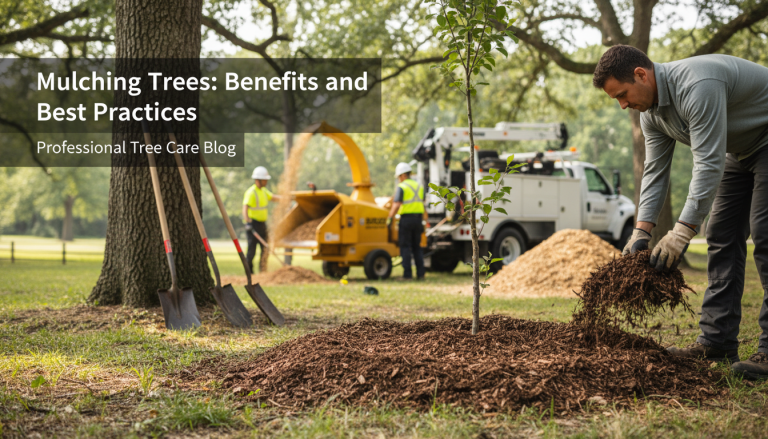
Keep heavy machinery off the root zone. Compacted soil suffocates roots, leading to dieback and instability. Apply a layer of organic mulch around the base (but not touching the trunk) to retain moisture and improve soil quality.
Don’t Guess with Safety
Assessing tree risk is a blend of biology, physics, and experience. While this guide helps you spot the obvious signs, the line between a “character tree” and a “hazard tree” is often thin. A tree that looks green and lush on the outside can be completely hollow on the inside.
If you identified any of the red flags mentioned above, or if you simply feel uneasy about a large tree on your property, you need a professional opinion. Certified arborists carry the training and insurance to handle these situations safely. They can provide you with options ranging from pruning and cabling to complete removal.
Browse our directory today to find a qualified [tree service contractor near you](#). Ensure your home remains safe through every season.